Message to Tomorrow…

Dear Friends,
Welcome to January’s Substack.
I hope you’ll enjoy this month’s blog Message to Tomorrow… The audio version is available by clicking the link in the blog or clicking the link here for all podcasts. https://joanneleedomackerman.substack.com/podcast
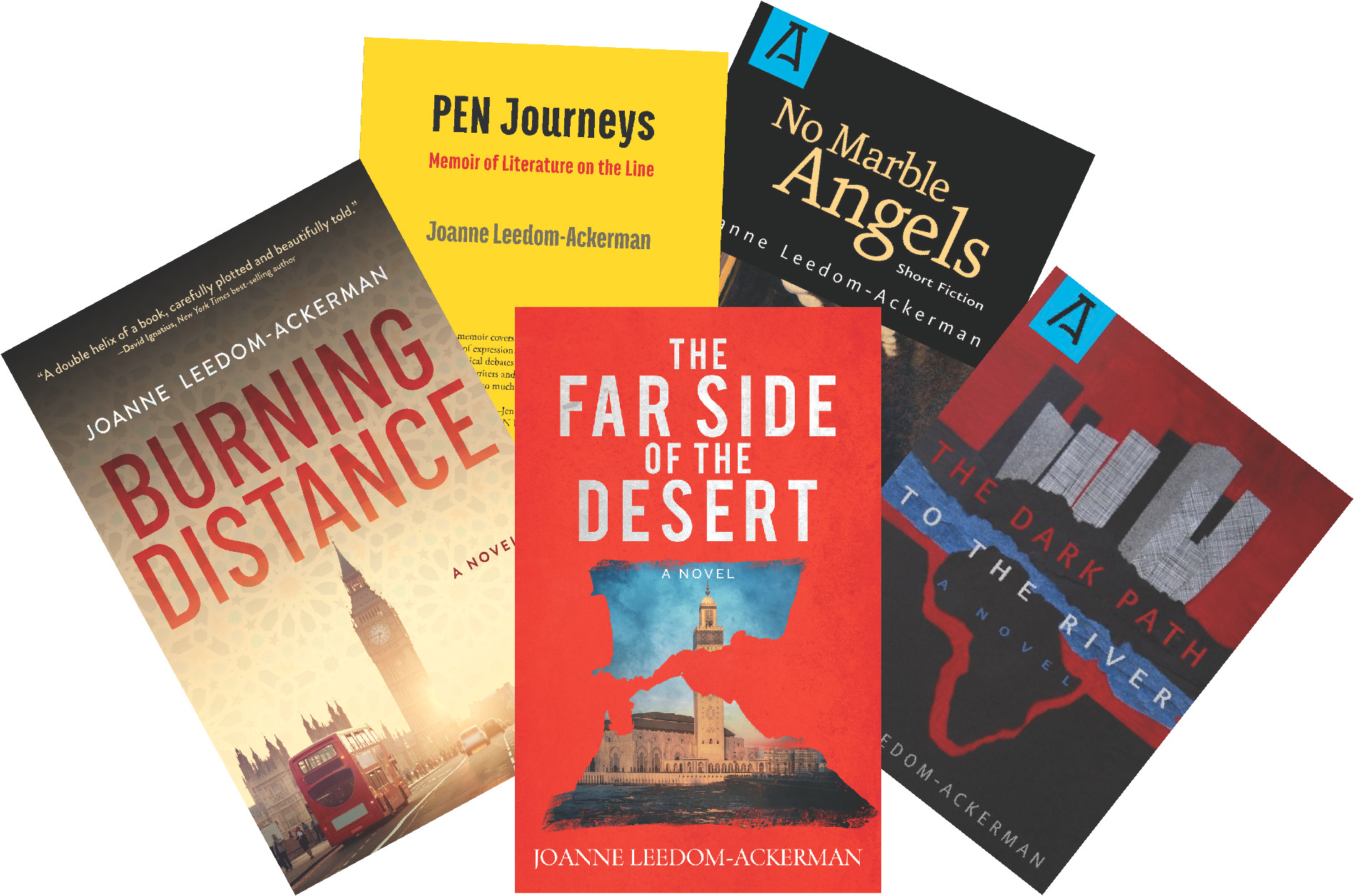
Book News shares information, appearances, awards, and interviews on my latest novels Burning Distance and The Far Side of the Desert.
The Writer at Risk section this month focuses on imprisoned poet, blogger and human rights activist Ahmed Mansoor of the United Arab Emirates (UAE).
The Books to Check Out section features John le Carré’s compelling stories from his life as linked to his fiction in The Pigeon Tunnel and Michael Connelly’s newest novel The Proving Ground in the Lincoln Lawyer series, unravels a provocative story about misuses of AI without guardrails.
In the Scene section you’ll find a photo relating to text from my novel Burning Distance. Words of the Month share a couple of words you may not use but might enjoy knowing.
Thank you to everyone who has come to bookstores, libraries, book clubs and online for my novels Burning Distance and The Far Side of the Desert. Word of mouth sells books so thank you for spreading the word!
If you’d like to have me speak at a venue or with a book club, click here. Thank you too for reading and sharing this free monthly Substack On the Yellow Brick Road. I hope you’ll stay in touch!


Message to Tomorrow…
At the threshold of a new year, stepping out beyond the footprints of the old, I walk on.
The known and unknown ahead.
And the unexpected.
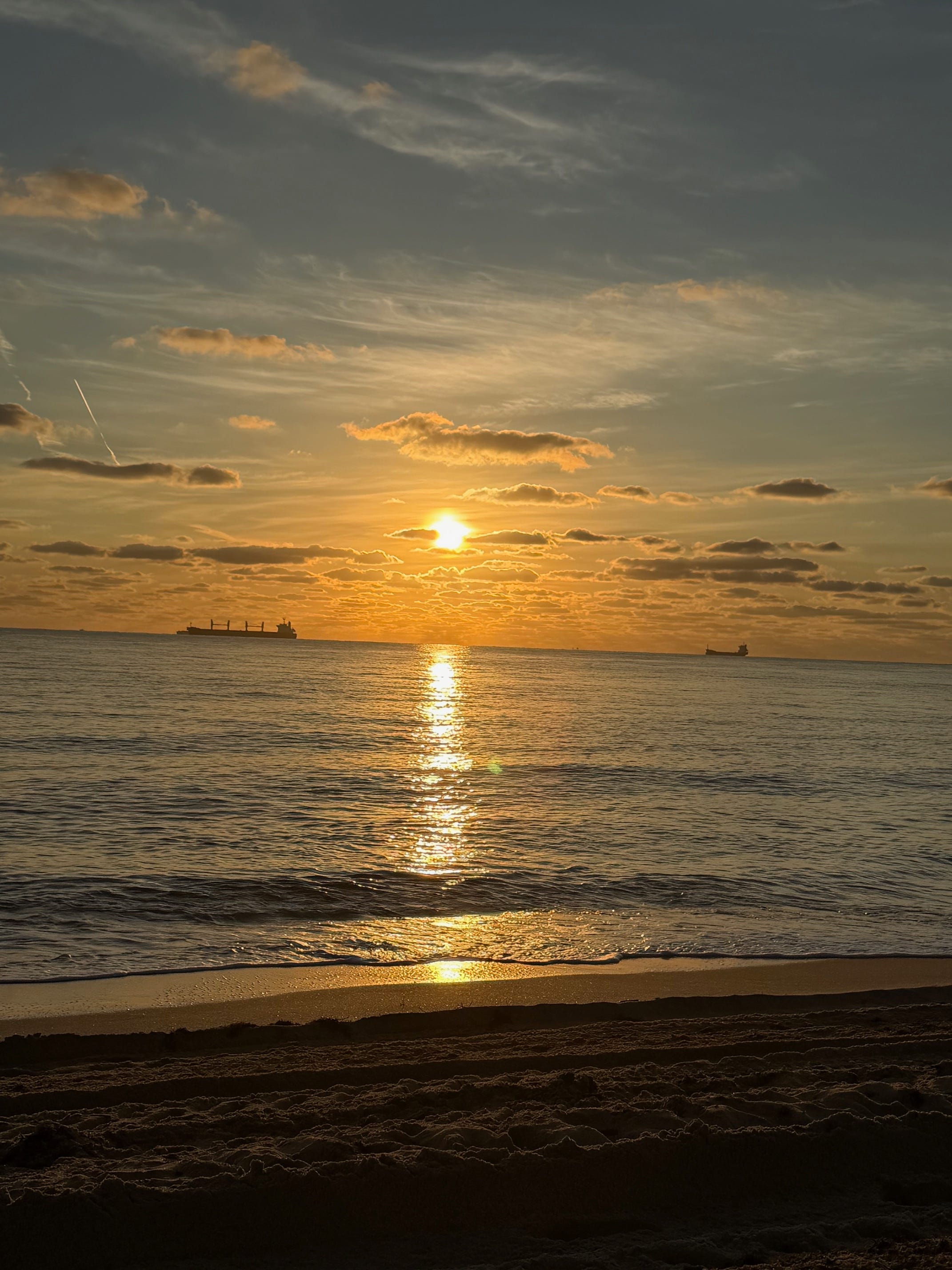
I choose a red, not a white car to drive into the new year on the roads and highways of this new destination in Florida…by the beach, by the ocean with the surging Atlantic and the sun rising on the horizon every morning out my window over the endless water.


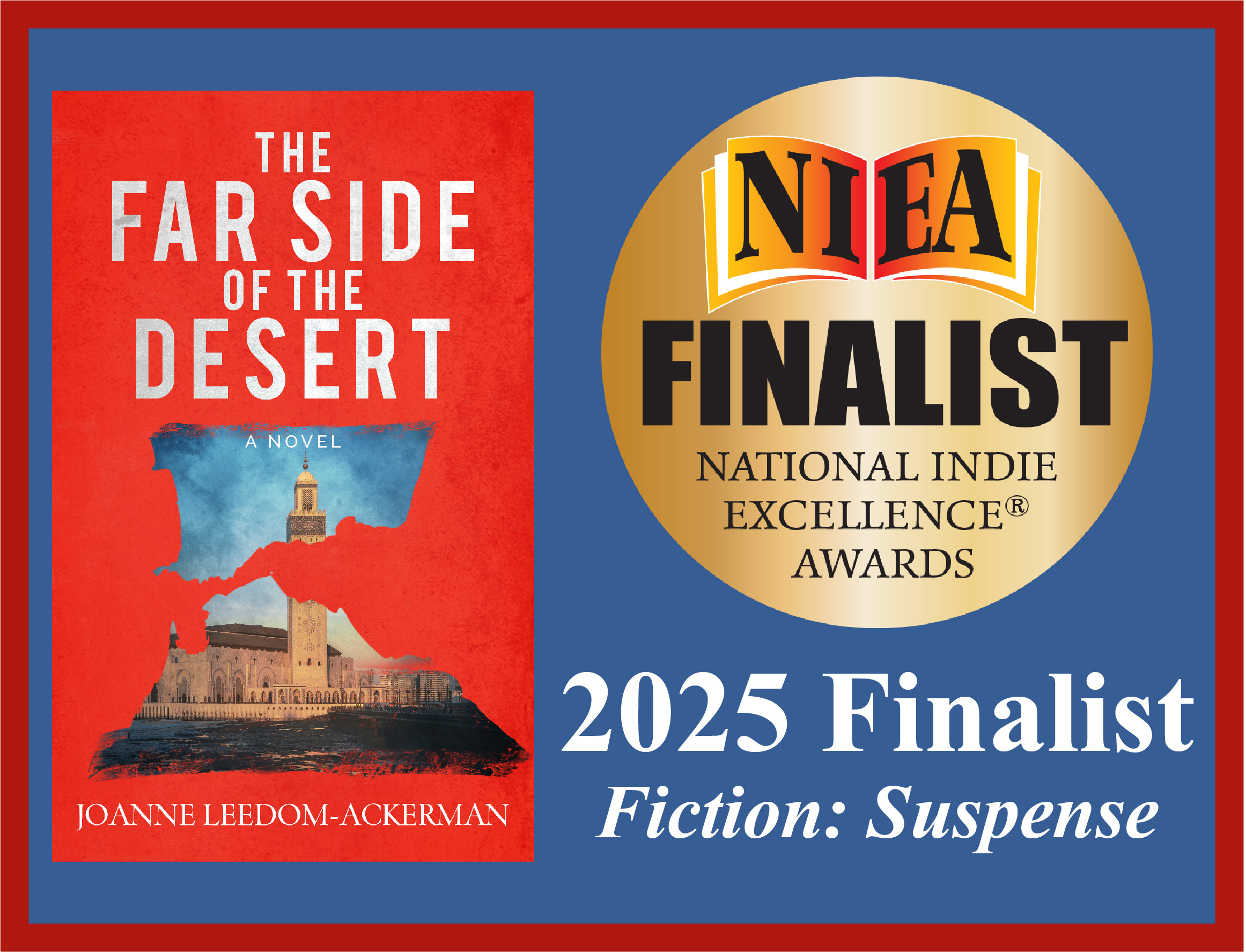
I’m honored that The Far Side of the Desert (Oceanview Publishing) was named a finalist in the Suspense category for the 2025 National Indie Excellence Awards. The novel was also awarded the 2025 Bronze medal in the Suspense/Thriller category by the Independent Publishers Association (IPPY) Book Awards.
Published in 2024, The Far Side of the Desert was released in paperback April, 2025. I hope you’ll order, read and enjoy. If you’ve already read the hardcover, I hope you’ll buy the paperback and give to friends!

“Alliances—familial, situational, political—gird this engrossing thriller from novelist Joanne Leedom-Ackerman. U.S. foreign service officer Monte disappears during a visit to Spain; the search to find her, spearheaded by older sister Samantha, ricochets from Morocco and Egypt to Washington. Monte’s captivity is brutal, but there’s resilience, too, as both sisters slay old demons and chart new paths.”
—The Christian Science Monitor (Best 10 books of March 2024)
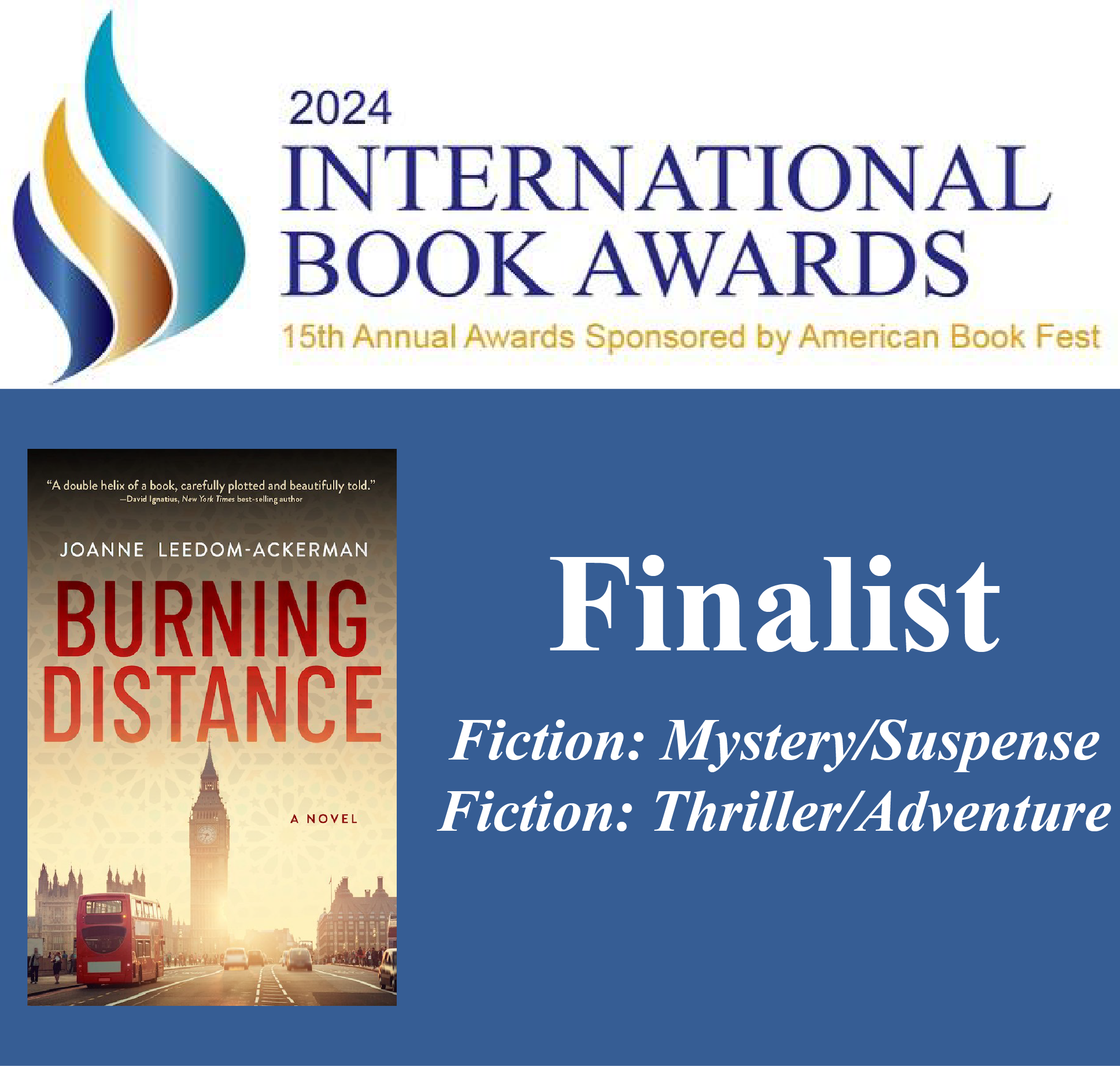
Burning Distance (Oceanview Publishing, 2023 and paperback in 2024) was honored by the 2024 American Book Fest International Book Awards as a Finalist in the Best Mystery/Suspense and Thriller/Adventure categories.
“Lizzy is ten when her father’s plane explodes over the Persian Gulf and her life is set in motion. In the background of the narrative is the Gulf War and in Lizzy’s life, her father’s death marks the beginning of a search to peel away secrets, betrayals, international intrigue, dangerous associations which bring all the characters in this book under one umbrella. Burning Distance is a mystery, a complicated, story-driven drama of lives lived amidst the high risk of life and death in international arms trading and the book is grounded by the unlikely love story between Lizzy and Adil Hasan. Her obsession is to uncover the secrets which led to her father’s death and in her quest she comes to find that everyone in this story is linked by danger, everyone is at risk. This is a real page turner which also informs, excites and moves us.”
—Susan Richards Shreve, acclaimed author of More News Tomorrow, Plum & Jaggers
Thanks to Monica Hadley and Writers Voices for the recent interview about The Far Side of the Desert. You can listen here.

Selected recordings of past events and interviews:
Interview with Monica Hadley, Writers Voices
Strategies for Living Podcast: Finding Resilience Through Story
Interview with Janeane Bernstein on NPR’s KUCI, Get the Funk Out!
Book Launch for Akram Aylisli's People and Trees with Plamen Press
Why Baldwin Matters Series, The Alan Cheuse International Writers Center
Malaprop’s Bookstore and Café in Asheville, NC
Kinokuniya Bookstore in New York City with Salil Tripathi
Baum on Books on WSHU Public Radio
Interview with Anna Roins of Authorlink
Interview with Deborah Kalb
For more podcasts, videos and interviews, click here

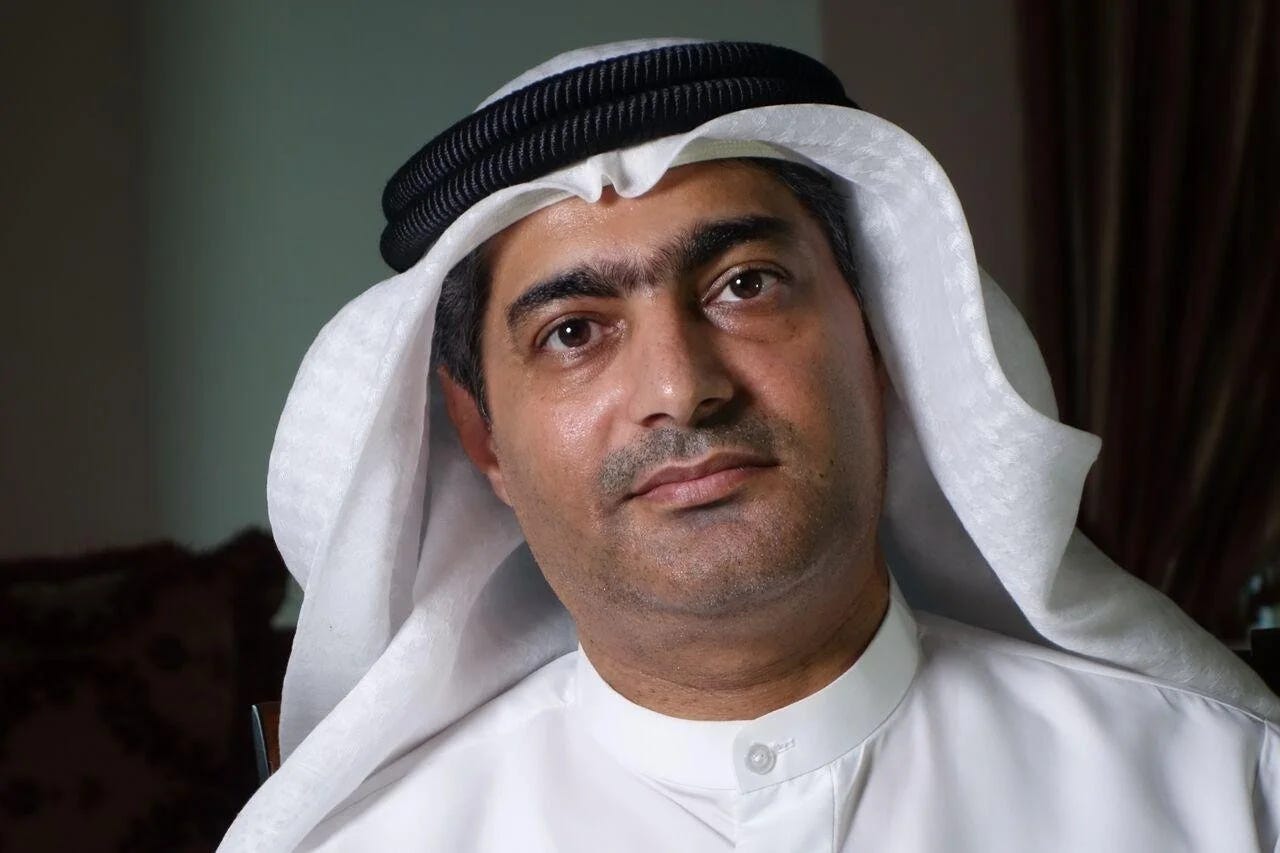
Ahmed Mansoor (United Arab Emirates)
(Sources: PEN International, Human Rights Watch, Amnesty International, Gulf Center for Human Rights)
Noted human rights defender, poet, and blogger Ahmed Mansoor is facing his ninth year in prison on charges of insulting the status and prestige of the United Arab Emirates by portraying the UAE as lawless and highlighting the detention, torture and unfair trials of dissenters and the problems with the judicial system and national laws that violate international laws.
One of the UAE’s most prominent human rights defenders, Mansoor has documented abuses since 2006 in his blog, social media and in interviews with the international press. He received the prestigious Martin Ennals Award for Human Rights Defenders in 2015 and has been a member of the Human Rights Watch Middle East and North Africa Advisory Committee and the Advisory Board of the organization Gulf Centre for Human Rights (GCHR.)
In 2017 security forces raided his home just before midnight, and for over a year he was arbitrarily detained with no one knowing where he was. Finally in May 2018 he was sentenced to 10 years in prison for “insulting the UAE and its symbols,” among other charges, and fined 1,000,000 Emirati Dirhams (around US$272,000), and three years surveillance upon release.
He has twice gone on hunger strikes but allegedly has been given little medical care and only allowed to go outside three times a week for a short time when no other prisoners are around. He has spent years in solitary confinement. For much of that time he is said to have been sleeping on the ground with no bed, no mattress, no pillow and with his glasses and reading materials taken from him.
In July 2024, the Abu Dhabi Federal Appeals Court sentenced Mansoor in a closed trial to an additional 15 years in prison, accusing him, along with other defendants, of establishing a clandestine terrorist organization known as the “Justice and Dignity Committee.”
Human Rights Watch and the Gulf Centre for Human Rights have detailed the UAE’s mistreatment of Mansoor in a joint 30-page report: “The Persecution of Ahmed Mansoor: How the United Arab Emirates Silenced its Most Famous Human Rights Activist.”
“Our courageous colleague Ahmed Mansoor is facing very dangerous targeting that threatens his life,” said Khalid Ibrahim, GCHR’s executive director. “In addition to completely isolating him from the outside world and preventing him from accessing the necessary medical care, authorities are working systematically to psychologically break him down. This requires urgent action by all international mechanisms and governments concerned with human rights to save his life.”
To Take Action for Ahmed Mansoor:
Urge the UAE authorities to:
Drop charges and immediately release Ahmed Mansoor
Pending release, ensure that Mansoor is granted prompt, regular, and unrestricted access to care and other basic necessities
Send Appeals to:
Please send emails to the Embassy of the United Arab Emirates in in your own country.

PEN International and others welcome the long-awaited release of PEN members Ales Bialiatski (Substack October 2024) and Maksim Znak (Substack May 2024) and fellow writers after years behind bars and continues urging #Belarus to free all those still held. #FreeThemAll
Reuters Dec 13, 2025:
”Human rights campaigner Ales Bialiatski fought for decades on behalf of political prisoners in Belarus, earning the Nobel Peace Prize but paying the cost of his own freedom.
“The Nobel award in 2022 made Bialiatski a globally recognised symbol of resistance to the authoritarian rule of President Alexander Lukashenko, a close ally of Russia’s Vladimir Putin who during his three decades in power has crushed all opposition in the former Soviet state of 9 million people.”

An attack on a writer, the shutting down of a publishing house, the torching of a newspaper reduce the space in the world where ideas can flow. Freedom of expression is vital to writers and to readers but is challenged daily around the world. Listed here are organizations whose work on human rights and in particular issues of freedom of expression I’ve been engaged with directly and indirectly over the years. Some of the organizations have broader agendas, but all have contributed to keeping space open for the individual voice.
PEN International (with its 147 centers in over 100 countries)
PEN American Center
English PEN
PEN/Faulkner Foundation
Human Rights Watch
Amnesty International
Amnesty International USA
International Freedom of Expression Exchange (IFEX)
Committee to Protect Journalists (CPJ)
Article 19
Index on Censorship
Poets and Writers
Authors Guild
International Center for Journalists

This month features a remarkable memoir I’d never read: The Pigeon Tunnel: Stories of My Life by John le Carré, master novelist, especially of espionage fiction. In his dramatic prose, le Carré takes the reader behind the scenes of his craft and of political events and introduces real life characters who inspired and provided background for many of his novels, especially those set in the last half of the twentieth century as the Soviet Union fell apart.
I also recently read Michael Connelly’s newest novel The Proving Ground. A Lincoln Lawyer novel which showcases familiar and beloved characters and introduces the reader to a case challenging AI without controls in the decades ahead of the 21st century.
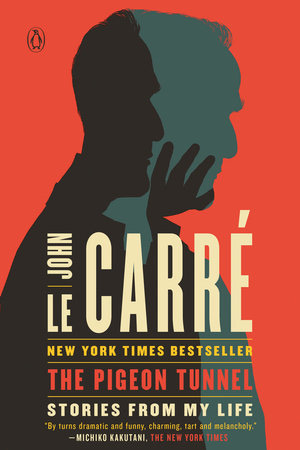
John le Carré (aka David Cornwell) lived a life intertwined with history in the 20th and early 21st centuries as a young student mastering German in Bern, Switzerland where he studied and at 17 first worked for British Intelligence, then during World War II where he was assigned intelligence duties in Occupied Austria for his National Service, then studied at Oxford focusing on German literature and language, a short career teaching at Eton, then another short career working with MI 5 & 6 as a spy posted at the British Embassy in Bonn as a junior diplomat, and then a novelist as he is now known worldwide.
At 84 years old, le Carré drew together his memories and stories of real life, including interviews he did that shaped his fiction. In The Pigeon Tunnel he takes the reader backstage in the creation of such novels as The Spy Who Came into the Cold, Tinker Tailor Soldier Spy, The Honourable Schoolboy, Smiley’s People, A Perfect Spy, and others. He shares dramatic incidents from his own life and also from those he has met and sought out to meet.
The chapter “The biggest bears in the garden” includes meetings with two former heads of the KGB, including Yevgeny Primakov who went on to be Russian Foreign Minister after the breakup of the Soviet Union.
In one incident Primakov requested to dine with le Carré and his wife at the Russian Embassy in London during the run-up to the first Gulf War. Le Carré recalls the conversation:
“‘You know Desert Storm, David?’ Primakov demands.
‘Yes, Yevgeny, I know Desert Storm.’
‘Saddam, he was a friend from me. You know what I mean by friend, David?’
‘Yes, Yevgeny, I think in this context I know what you mean by friend.’
‘Saddam, he telephones to me’ – indignation mounting – ‘Yevgeny. Save my face. Get me out of Kuwait.’
He allows time for the significance of this request to sink in. Gradually it does. He is telling me that Saddam Hussein asked him to persuade George Bush Senior to let him pull his forces out of Kuwait with dignity – save his face – in which case there need be no war between the United States and Iraq.
‘So I go to Bush,’ he continues, striking angrily at the name. ‘This man is’ – tense discussion with the interpreter. If it is on the tip of Primakov’s tongue to use strong language to describe George Bush Senior, he restrains himself.
‘This Bush is not cooperative,’ he asserts reluctantly, and allows himself a grimace of indignation. ‘Therefore I come to England,’ he resumes. ‘To Britain. To your Thatcher. I come’ – another flurried consultation with his interpreter, and this time I catch the Russian word dacha, which is about the only one I know.
‘Chequers,’ says the interpreter.
‘So I come to Chequers.’ A hand flies up commanding our silence, but the entire table is dead silent already. ‘For one hour this woman lectures me. They want the war!’”
This incident as many in the memoir show le Carré gathering historical backstory and characters for his novels.
The son of a legendary con man, le Carré observed worlds of half-truths and human manipulation, the stories that we make up and the stories that shape our perception of life around us. The Pigeon Tunnel is not an ordinary memoir; it is the work of a master storyteller, threading history, memory and craft into a tapestry not to be missed, though for a decade I am among those who missed reading it.
From The Pigeon Tunnel:
There is scarcely a book of mine that didn’t have The Pigeon Tunnel at some time or another as its working title. Its origin is easily explained. I was in my mid-teens when my father decided to take me on one of his gambling sprees to Monte Carlo. Close by the old casino stood the sporting club, and at its base lay a stretch of lawn and a shooting range looking out to sea. Under the lawn ran small, parallel tunnels that emerged in a row at the sea’s edge. Into them were inserted live pigeons that had been hatched and trapped on the casino roof. Their job was to flutter their way along the pitch-dark tunnel until they emerged in the Mediterranean sky as targets for well-lunched sporting gentlemen who were standing or lying in wait with their shotguns. Pigeons who were missed or merely winged then did what pigeons do. They returned to the place of their birth on the casino roof, where the same traps awaited them.
Quite why this image has haunted me for so long is something the reader is perhaps better able to judge than I am.
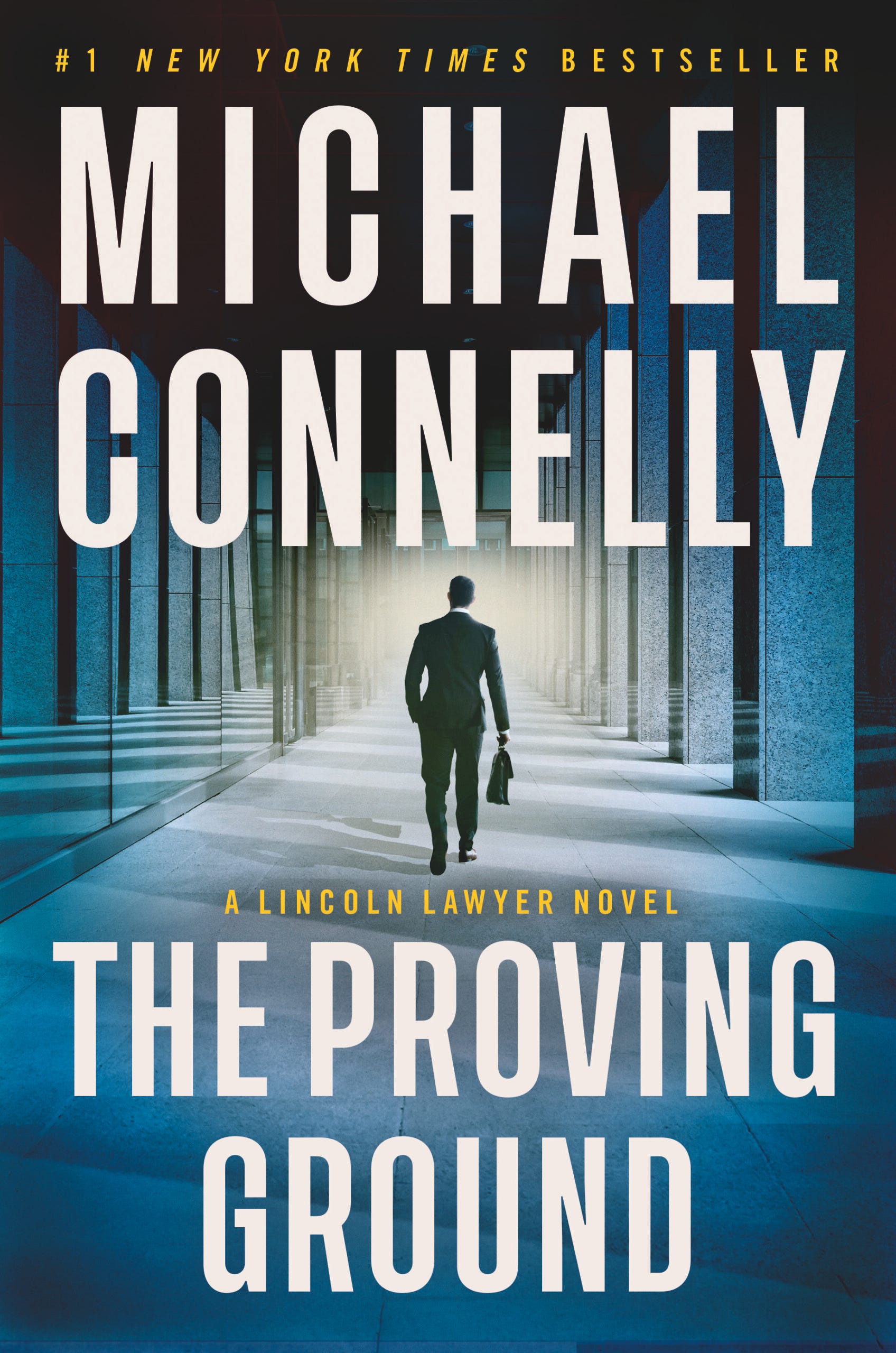
In Michael Connelly’s The Proving Ground, Attorney Michael (Mickey) Haller, known as the Lincoln lawyer, returns to the courtroom to “a fight for the future of everyone—or at least that was how I would argue it.”
The case is against Tidalwaiv, an artificial intelligence company hoping to be bought out for millions or billions by one of the three big M’s—Meta, Microsoft or Musk—in the competitive world of generative artificial intelligence. Haller’s clients are the parents of the victim and of the perpetrator of a murder when the generative AI creation Clair “told an impressionable young man to take his father’s gun to school and…” murder his former girlfriend.
The courtroom drama takes the reader behind the scenes of how generative artificial intelligence works interacting with its user and insists on the need for guardrails and controls on the content.
From The Proving Ground:
To some it’s a stage. A place where carefully choreographed drama takes place. To others, a chess match with moves designed and practiced weeks and sometimes months in advance. Where nothing is left to chance. Where the wrong moves have grave consequences and finality. Where the recruited audience sits in silent judgment with their hidden biases and contempt.
I have never thought of it that way. To me it’s the Octagon, where mixed martial arts are deployed in brutal combat. Two go in; one comes out the victor. No one is left unbloodied. No one is left unscarred. This is what the courtroom is to me.
The hearing on this day was in civil court, a misnomer if there ever was one. There was nothing remotely civil about this fight. Randolph versus Tidalwaiv Technologies LLC was one of those rare cases where the stakes went far beyond the walls of the courtroom or even the reach of the federal court for the Central District of California. This was a fight for the future of everyone—or at least that was how I would argue it.
It was a pretrial hearing before US district court judge Margaret Ruhlin. I had known her since her days as a member of the local defense bar, back when she was called Peggy Ruhlin and hung out after court hours at the bar at the Redbird. She was now a veteran and much respected jurist appointed to the bench during the Obama years. She had consolidated cross-complaints from the parties and was attempting to avoid a trial delay by refereeing the disputes. I was in favor of that but the lawyers at the other table, the Mason brothers, would have liked nothing better than to push the trial off for another few months or more. Tidalwaiv was for sale and its investors were hoping one of the big techs would swallow it. The three Ms were circling—Microsoft, Meta, and Musk. This trial and its outcome could be the difference between millions and billions.
I was determined not to let them delay…

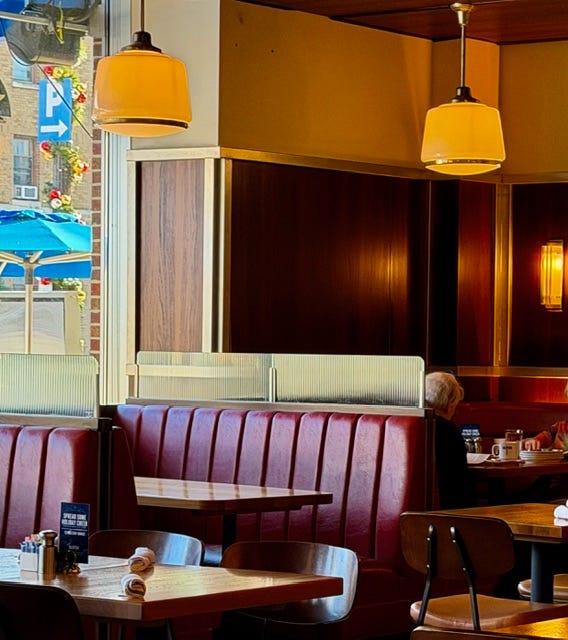
Image and passage of text from my novel Burning Distance:
He opened the lid and turned it towards me. On a black cloth lay a thick-barreled pistol. “It’s a gun,” I whispered. He’d walked through the streets carrying a gun, or more particularly, as I was to learn later, a semi-automatic nine-millimeter. “Why did my father have a gun?”
Marvin Penn smiled. “To protect himself. And for target practice.”
I leaned closer so Marvin Penn wouldn’t talk too loudly. I didn’t want my new friends hearing what he was saying. “What kind of targets?”
“Soviets…Chinese…Libyans...”
“Those are people.”
“They’re not ducks.” He smiled wider, showing blackened holes in the recesses of his mouth where his teeth were missing. He patted the pistol as if it were an obedient pet. “We trained for contingencies.”
“Did my father ever shoot at live targets?”
“If they shot at him.”
“Did he ever kill anyone?” I don’t know why I kept asking that question of Mom and now of Marvin Penn except the answer seemed to me defining. It set my father apart in a group of people who’d measured the worth of a life in a moment’s action. I’d spent half my life living with his absence—a shadow, an unoccupied space—I couldn’t fill. I wondered how he felt.

Over the years I’ve accumulated a running list of words I haven’t known from two main sources: WordDaily and WordGenius.
Exophthalmic
[ek säfˈ THal mik, ek säp THal mik/
Part of speech: adjective
having or characterized by protruding eyes.
Examples:
“But I do remember with certainty the exhaustion in Ward’s face as, aware that we were some sort of VIPs, he turned to greet us: the fraught, aquiline profile, skin stretched tight, the rigid smile and exophthalmic eyes reddened and ringed with tiredness; and the husky smoker’s voice, playing it for nonchalance.”—from John le Carré’s The Pigeon Tunnel
Liminal
[lim-ə-nəl]
Part of speech: adjective
occupying a position at, or on both sides of, a boundary or threshold.
relating to a transitional or initial stage of a process.
Examples:
“The subjects’ responses to liminal stimulation differed, with some responding and some not.”
“Confusion can strike in the liminal stages between waking and sleeping.”

I’ve spoken at bookstores, university classes, book luncheons and in-person and zoom book clubs and look forward to more ahead. I enjoy giving readings and addressing audiences in many venues and moderating discussions on a wide range of topics and most of all meeting readers.
Click here for a list of future and past public events.
Or fill out the speaking request form to schedule an event.
I like engaging with readers so if you are in a Reading Group or Book Club and read one of my books, I’m glad to be in touch by email, zoom, or when possible in person. I can also suggest discussion topics.
Fill out the reading group form here to schedule a meeting.